

Artificial Intelligence is changing how users discover information online. Traditional SEO is no longer just about ranking on Google’s first page — it’s now about becoming the source AI systems trust and cite.
From Google AI Overviews to ChatGPT, Gemini, Perplexity, and Claude, generative search engines are reshaping content visibility. Instead of showing users ten blue links, AI tools summarize answers instantly by pulling information from trusted websites.
This shift has created a new optimization strategy called Generative Engine Optimization (GEO).
If your content is not optimized for AI systems, you risk losing visibility, traffic, and authority — even if your traditional SEO rankings are strong.
In this guide, you’ll learn what On-Page GEO is, why it matters, and how to optimize your website so AI platforms can discover, understand, and cite your content.
What Is Generative Engine Optimization (GEO)?
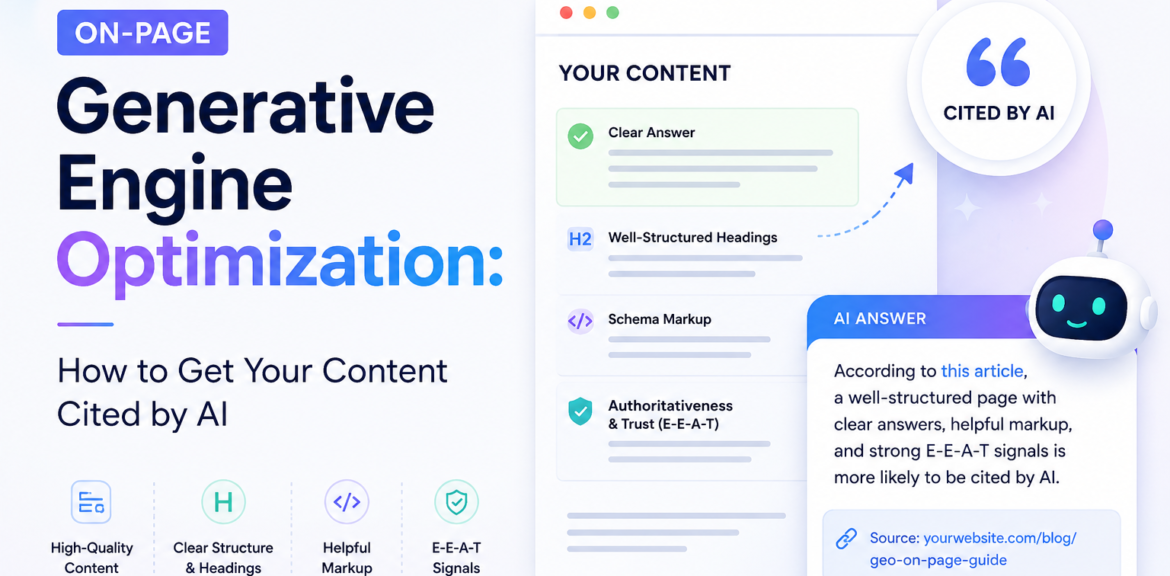
Generative Engine Optimization (GEO) is the process of optimizing content so AI-powered search engines and language models can easily understand, extract, and reference your information in generated answers.
Unlike traditional SEO, which focuses on rankings and keywords, GEO focuses on:
- Content clarity
- Semantic understanding
- Entity recognition
- Structured information
- Topical authority
- AI-readable formatting
The goal is simple:
Make your content easy for AI systems to trust, summarize, and cite.
Why GEO Matters in 2026
Search behavior is changing rapidly.
Users are increasingly relying on AI-generated answers instead of clicking through multiple websites. Google’s AI Overviews, ChatGPT browsing, and Perplexity responses often provide complete answers directly within the interface.
This means websites now compete for:
- AI citations
- Featured snippets
- Knowledge extraction
- Semantic authority
If AI engines repeatedly cite your website, you gain:
- Higher brand visibility
- Increased authority
- Better organic trust signals
- More qualified traffic
- Future-proof SEO performance
Websites that fail to adapt may see reduced click-through rates, even if they still rank well traditionally.
Difference Between SEO and GEO
| Traditional SEO | Generative Engine Optimization |
|---|---|
| Focuses on rankings | Focuses on AI citations |
| Keyword-heavy optimization | Semantic and contextual optimization |
| Targets search engines | Targets AI systems and LLMs |
| Optimizes metadata | Optimizes knowledge extraction |
| Link-centric | Entity-centric |
| Click-based visibility | Mention and citation-based visibility |
Modern content strategies should combine both SEO and GEO for maximum search visibility.
How AI Systems Choose Content to Cite
AI models typically prioritize content that is:
- Well-structured
- Factually clear
- Easy to summarize
- Contextually relevant
- Authoritative
- Updated regularly
- Supported by entities and semantic signals
AI systems also favor pages with:
- Proper heading structures
- Concise explanations
- Schema markup
- High topical depth
- Natural language formatting
- FAQ sections
- Credible references
Thin content and keyword stuffing rarely perform well in AI-generated search environments.
Core On-Page GEO Strategies
1. Write for Topics, Not Just Keywords
Traditional SEO often focused on exact-match keywords.
GEO focuses on topical relevance and semantic relationships.
Instead of targeting only:
“best CRM software”
Your content should naturally include related concepts like:
- sales automation
- customer management
- lead tracking
- workflow integration
- SaaS platforms
- business productivity
AI engines understand relationships between concepts, not just keyword repetition.
Best Practice:
Build comprehensive topic clusters instead of isolated keyword pages.
2. Use Clear Heading Structures
AI systems rely heavily on content structure to understand page hierarchy.
Use:
- H1 for the main topic
- H2 for primary sections
- H3 for supporting details
- Bullet points for scannable information
Example:
What Is GEO?
Benefits of GEO
GEO vs SEO
GEO Ranking Factors
This structure improves:
- AI readability
- Featured snippet potential
- Information extraction
3. Optimize for Entity Recognition
Entities are people, places, brands, tools, organizations, and concepts AI systems recognize independently.
For example:
- OpenAI
- ChatGPT
- Perplexity
- Generative AI
- Semantic Search
Mentioning relevant entities naturally helps AI systems understand your content context more accurately.
Pro Tip:
Use entity-rich content instead of repetitive keyword stuffing.
4. Add FAQ Sections
AI systems frequently pull answers from FAQ sections because they provide:
- Direct questions
- Concise answers
- Structured information
Example FAQs:
- What is GEO?
- How does GEO work?
- Is GEO replacing SEO?
- How do AI search engines rank content?
FAQ sections improve:
- AI extraction
- Voice search visibility
- Featured snippets
- User engagement
5. Use Conversational Language
Large language models are trained on natural human conversations.
Content written in overly robotic or keyword-heavy language becomes harder for AI systems to use naturally.
Write:
- Clearly
- Naturally
- Conversationally
- Authoritatively
Good GEO content sounds like a knowledgeable expert explaining a topic simply.
6. Build Topical Authority
AI engines prefer websites demonstrating deep expertise.
Instead of publishing random blog posts, create interconnected content around a niche.
Example for digital marketing:
- GEO optimization
- AI SEO
- Semantic search
- Technical SEO
- AI content strategy
- Structured data
- Search intent optimization
The more topical depth your site has, the more trustworthy it appears to AI systems.
7. Use Schema Markup
Structured data helps AI systems understand your page context.
Important schema types include:
- Article Schema
- FAQ Schema
- Organization Schema
- Breadcrumb Schema
- Author Schema
Schema improves:
- Search understanding
- Rich results
- AI extraction capabilities
8. Include Statistics and Original Insights
AI engines prioritize unique and authoritative information.
Adding:
- Data
- Case studies
- Research
- Industry insights
- Expert commentary
makes your content more cite-worthy.
Original insights increase the likelihood of:
- AI citations
- backlinks
- mentions
- authority signals
GEO Content Formatting Best Practices
Use:
- Short paragraphs
- Bullet points
- Numbered lists
- Tables
- Definitions
- Step-by-step explanations
Avoid:
- Large text walls
- Keyword stuffing
- Vague explanations
- Clickbait content
- Thin AI-generated filler
AI systems prefer content that is easy to scan and summarize.
The Importance of E-E-A-T in GEO
Google’s E-E-A-T principles are now even more important in AI-driven search.
E-E-A-T stands for:
- Experience
- Expertise
- Authoritativeness
- Trustworthiness
To strengthen E-E-A-T:
- Include author bios
- Show credentials
- Cite reliable sources
- Keep content updated
- Publish original research
- Build a trusted brand presence
AI systems tend to favor content from credible, authoritative sources.
GEO Optimization Checklist
Before publishing content, ask:
Does the page:
- Answer user intent clearly?
- Include semantic topic coverage?
- Use structured headings?
- Mention relevant entities?
- Include FAQs?
- Use schema markup?
- Demonstrate expertise?
- Provide unique value?
- Read naturally?
- Offer concise explanations?
If yes, your content is more likely to be cited by AI systems.
Common GEO Mistakes to Avoid
1. Overusing Keywords
AI understands context better than exact repetition.
2. Publishing Thin Content
Short, shallow articles rarely earn AI citations.
3. Ignoring Semantic Search
Content should cover related concepts comprehensively.
4. Using Poor Structure
Messy formatting makes AI extraction difficult.
5. Relying Entirely on AI-Generated Content
Human expertise and originality remain essential.
Future of GEO and AI Search
Generative search is still evolving, but one trend is clear:
AI-driven discovery will become a dominant traffic source.
Businesses that optimize early for GEO will gain:
- Higher visibility
- Better brand recognition
- Long-term authority
- Increased organic trust
The future of search is not just ranking.
It’s becoming the source AI trusts enough to mention.
Final Thoughts
On-Page Generative Engine Optimization is the next evolution of search optimization.
As AI-powered search engines continue reshaping digital discovery, businesses must move beyond traditional keyword strategies and focus on semantic clarity, topical authority, and AI-readable content structures.
The websites that succeed in the future will be the ones that:
- educate clearly,
- structure content intelligently,
- demonstrate expertise,
- and provide genuine value.
If you want AI systems like ChatGPT, Google AI Overviews, Gemini, and Perplexity to cite your content, GEO is no longer optional — it’s essential.
Start optimizing today, and position your website for the future of AI-powered search.